
Resonances 1: Departure(s)
On sharing, carving space, thinking in public.

I’ve been reading Julian Barnes’ new novel, Departure(s). Midway through, the following line gave me pause:
I have found myself thinking a lot in recent years about how we remember the dead, about how quickly memory becomes myth and once-living people are turned into a set of anecdotes (but how could it be otherwise?).
It made me think of my eldest sister. I grew up with three sisters. The eldest, Aimal, passed away in late 2017.
The thought that crossed my mind, stopped me there: We hardly ever tell anecdotes of Amy.
We do, and we have, but it isn’t a strictly untrue thought.
“Hardly ever,” because for much of the years since (how quick is “quickly,” in this calculus?), we’ve not often been near those who knew her in the ways that give occasion for tale-telling. Not collectively, and not in terms of sustained, physical nearness.
We’ve been scattered across countries (Pakistan, the United States, Canada), across cities (Karachi, Lahore, Santa Barbara, New York, Toronto), coasts, boroughs. And when we aren’t scattered, all of us together (there has been only one occasion for this, since we all flew towards her funeral), or some few of us, there is life (which goes on) and all the little and large things it brings that are (or seem) pressing.
Parsed that way, this is in my mind a violence of distance and borders: How loss becomes a private grief, unshared, even if there are those who did share it (the loss) and would and do share it (the grief).
I’ve been thinking a lot about sharing, lately—about pushing myself to it, so I might be a more complete version of myself in the world.
Or perhaps I merely want to talk about my sister.
On the one hand: There are so many things that I do that even those most directly in my orbit are unaware of. A personal orientation towards privacy, alloyed with messaging internalized over years spent in academia has left me with the difficult-to-shake sense that output must be perfected before it’s worthy of sharing, and anything less smacks of dilettantism at the expense of depth.
On the other hand: so many of those pursuits are inflected by or entirely tangled up with her loss, and with her ongoing presence in my life:
The fiction, written for workshops or during self-created retreats, in which loss is couched in the fantastical; or expressed through autoethnographic realism, paired with the simple distancing from subjectivity afforded by inventing names for actual persons.
The chapter for an academic collection, recently turned in, that both draws on my dissertation and ranges beyond it to take up memorial gatherings in networked worlds.
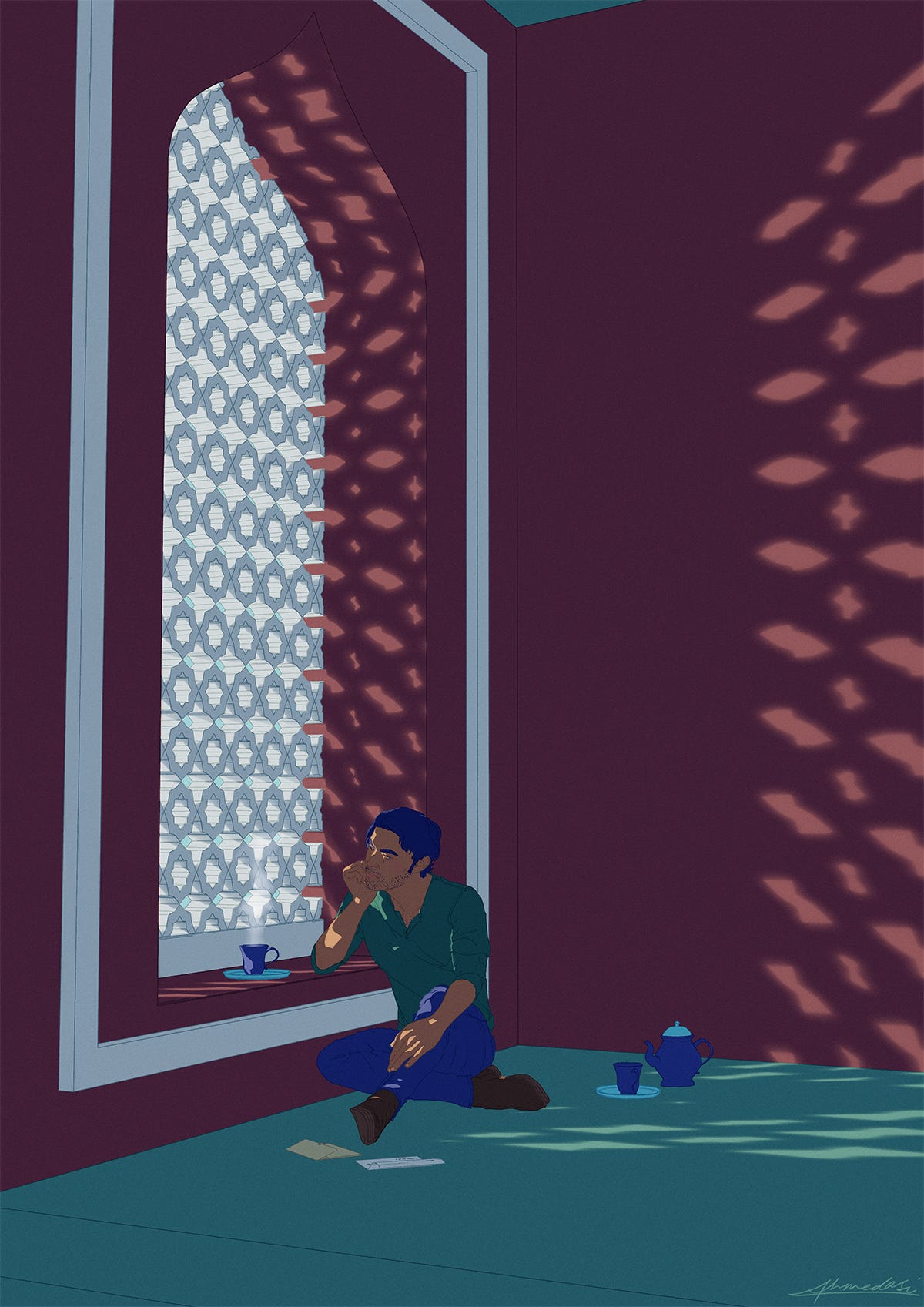
The illustrations, both completed and in process. In the former, the figure that appears flying past windows or stepping through portals is a version of her—an adventurer, in my mind, always, framed by liminal architectures and so entering a publicly-shared context edgewise and aslant. The latter, a multi-piece project called “Seasons of Mourning,” has been with me in one form or another for many seasons, now, across mediums and developing approaches: as half-finished iterations that function as studies; as plans for possible directions; as bricks of learning that are building towards a version that is both ambitious and, and so, for some seasons still, out of reach.
The screenplay pilot in progress (a natural extension of my toggling between the literary and the visual, not to mention of much media, consumed). Set in the aftermath of an environmental and a personal tragedy, it is informed by her passing in ways both knowingly designed and that unknowingly sneak up on me.
The logo, designed for a book-focused browser extension, that resolved into a staircase made out of four books. Stairs, and art, and words, as liminal architecture, again. Four, because it was always four of us, reading together, until it wasn’t.
A part of me thinks it self-indulgent to speak of these things, and in this way: to enumerate a range of pursuits and preoccupations, and to speak of them through the registers of mostly-private grief.
Another part is trying to be better about embodying a counterargument that I know, intellectually, as a person of color who has spent much of his life in institutions that too-often read and render the othered through the logics of too-much-ness.
A part of my orientation towards privacy, I know, is readymade material for that institutional logic, scaffolding my entrainment in self-accorded restraint, the hushed voice and the rhetoric of civility and the inclination towards withholding become a politely-couched mechanism for space, and value, withheld. “[W]orthy of sharing” is the phrase I used, earlier—cognizant that there is a fine and precise line, institutionally, between what is considered worthy of sharing and what, and who, is considered worthy of according space.
We must, I think, indulge the self in order to know the self, and to value the self. Just as we must articulate what we believe in order to know that we believe it, we must indulge possibilities for ourselves in order to believe that we can move towards institutionally-unimagined horizons.
That is my project, here. To carve out a little space and take it up. To think in public, and across domains. To share things that have resonated with me, and understand that resonance to be worthy of sharing.
Which brings me back to the line from Barnes that initiated this reflection.
I’ve talked here about sharing: anecdotes, thoughts, projects, self. I’ve said less about myth. Perhaps an anecdote about myth will suffice as a final thought.
In senior year of college, the capstone course for Theater and Dance majors required a seminar paper as part of a final presentation. Mine was about the rhythms and the functions of myth. While facilitating the discussion that followed, it was pointed out to me that I tended to hit the “my” in “mythology,” rendering it “my-thology”.
My accent has continued to shift and change over time, but perhaps there’s something to that inflection of the word, a happy accident of articulation and meaning. Myths exist, in part, to help us make sense of our worlds and of our experiences. If they are made efficacious through the stories we tell and the art we make, then the things I have made about and informed by my eldest sister (and what isn’t informed by her, who was in my life since I was born, and remains in it after she passed?) are part of my personal project of necessary myth- and sense-making.
Which means, I think, that whether I share these things, in whole or in part, as I’d like to, is in some sense immaterial—a thought I find powerful for two reasons.
Because it makes sharing a choice on my part, and taking up space a material and knowing action in the world.
And because it reminds me that, shared or unshared, her myth lives in me.
Dwelling on these things, then, becomes not an exercise in melancholy but in memory and in creation: tales told and artifacts shared with a companion that is with me, still.
I’ll leave the thoughts there, for the moment. If some part of this resonates with you, let me know, here, or in person (if you’re in my personal orbit). And thank you, in either case, for reading.
With warmth,
Ahmed
Love to hear you think love you in general ❤️